Showing posts with label Jenny. Show all posts

Sunday, July 15, 2012

E-selectin liposomal and nanotube-targeted delivery of doxorubicin to circulating tumor cells

http://www.sciencedirect.com/science/article/pii/S0168365912001435

Michael J. Mitchell, Christina S. Chen, Varun Ponmudi, Andrew D. Hughes, and Michael R. King

Liposomal doxorubicin with PEG and E-selectin coupled to the surface were used to study the possibility of targetting circulating tumor cells in the bloodstream. The E-selectin (selectins are naturally found on imflamed endothelial cells) was able to adhere to sialylated carbohydrate ligands that are often overexpressed on circulating tumor cells. The researchers were able to show that their nanoparticles immobilized along microtubules or in a cone-and-plate viscometer were able to target and kill cancer cells under shear flow, but not red blood cells.


Full-size image (62K)

In vivo temperature controlled ultrasound-mediated intracellular delivery of cell-impermeable compounds

Anna Yudina, Matthieu Lepetit-Coiffé, Mariska De Smet, Sander Langereis,
Holger Grüll, Chrit Moonen

http://www.sciencedirect.com/science/article/pii/S0168365912002593

 Thermosensitive liposomes made from 1,2-Dipalmitoyl-sn-glycero-3-phosphocholine (DPPC), 1-stearoyl-
2-hydroxy-sn-glycero-3-phosphocholine (MSPC) and 1,2-distearoyl-sn-glycero-3-phosphoethanolamine-N-[methoxy(polyethylene glycol)-2000] (DSPE-PEG2000) were use to encapsulate TO-PRO-3, a cell-impermeable molecule that binds to nucleic acid and increases its fluorescence. Ultrasound treatment using microbubbles was used to help promote internalization of these nanoparticles, and heating to 47C helped to release the fluorophore in mice, as observed by fluorescence imaging.

Full-size image (44K)

Sunday, July 8, 2012

Synthesis of Degradable Organic Nanotubes by Bottlebrush Molecular Templating

Kun Huang, Mark Johnson, and Javid Rzayev

http://pubs.acs.org/doi/abs/10.1021/mz3002287

Polymer bottlebrushes were synthesized by a graft from approach by polymerizing polylactide (PLA) from a poly(glycidyl methacrylate) backbone. Then poly(styrene-co-maleic anhydride) was polymerized from PLA by RAFT. Cysteamine was added to functionalize the maleic groups at the shell of the bottlebrush. The researchers funtionalized about 30% of the maleic anhydride, the rest was hydrolyzed to carboxylic acid groups. Oxidation of the thiol to disulfides was used to crosslink the shell of the brush, which was facilitated by I2, THF. Formation of disulfide bonds was confirmed by FTIR. The PLA core was then degraded by hydrolysis under basic conditions, forming hollow nanotube-like assemblies. The shell could be further degraded by reduction with DTT. FTIR, DLS, and TEM was used to help characterize the brushes.
Abstract Image

A “Mix-and-Click” Approach to Double Core−Shell Micelle Functionalization

Claire F. Hansell and Rachel K. O’Reilly

http://pubs.acs.org/doi/abs/10.1021/mz300230c

RAFT was used to create a block polymer consisting of a copolymer of styrene and styrene functionalized with  norbornene, followed by a copolymer of triethylene glycol acrylate and trimethylsilane protected propargyl acrylate, which was then deprotected. In water, this polymer self-assembled such that the hydrophobic norbornene block was in the core, and the hydrophilic alkyne block formed the shell. The researchers were able to click on a coumarin functionalized azide to the shell, and a tetrazine to the core. However, if both were added at the same time, functionalization was less efficient (50%), but this was overcome by clicking on the azide coumarin first, followed by the tetrazine (but not the other way around). These particles were studied by TEM, fluorescence spectroscopy, UV-vis, H-NMR, and GPC.
Abstract Image

Monday, July 2, 2012

Electron transfer-based combination therapy of cisplatin with tetramethyl-p-phenylenediamine for ovarian, cervical, and lung cancers

http://www.pnas.org/content/109/26/10175.full.pdf+html

 Ting Luo, Jianqing Yu, Jenny Nguyen, Chun-Rong Wang, Robert G. Bristow, David A. Jaffray, Xiao Zhen Zhou, Kun Ping Lu, and Qing-Bin Lu

Combination therapy with cisplatin and N,N,N', N'-tetramethyl-p-phenylenediamine (TMPD) enhanced the mechanism of cisplatin through a dissociative electron transfer reaction as observed by spectroscopic studies and gel electrophoresis. TMPD reduced the dose of cisplatin required. Even in cisplatin resistance human ovarian cells (NIH:OVCAR-3), cancer cells did not survive with cisplatin and TMPD combination treatment.

Mussel-Glue Derived Peptide−Polymer Conjugates to Realize Enzyme-Activated Antifouling Coatings

http://pubs.acs.org/doi/abs/10.1021/mz300258m
Patrick Wilke and Hans G. Börne

Polyethylene glycol was conjugated with the peptide sequence, AKPSYPPTYK, which is an adhesive sequence used by mussels. Upon activation by tyrosinase, the tyrosines in this sequence were converted into DOPA-quinone allowing the polymer conjugate to adhere to steel as shown by quartz crystal microbalance measurements. Kinetic experiments also showed the oxidation of tyrosines in the decapeptide and polymer conjugated decapeptide by tyrosinase.


Sunday, June 24, 2012

Facile Synthesis of Functionalized Lactones and Organocatalytic Ring-Opening Polymerization

Hyunuk Kim, Johan V. Olsson, James L. Hedrick, and Robert M. Waymouth

http://pubs.acs.org/doi/pdf/10.1021/mz3001397

An alpha-beta unsaturated valerolactone was functionalized with conjugate addition of a thiol.  Ring opening polymerization led to functionalized polyesters, but these substituted monomers underwent slower polymerization than the unfunctionalized. The group also showed copolymerization of functionalized valerolactone with caprolactone.

Abstract Image

Exploring thermal reversible hydrogels for stem cell expansion in three-dimensions

Zheyu Shen, Jingxiu Bi, Bingyang Shi, Dzuy Nguyen, Cory J. Xian,b Hu Zhang and Sheng Dai

http://pubs.rsc.org/en/Content/ArticleLanding/2012/SM/C2SM25407G?utm_source=feedburner&utm_medium=feed&utm_campaign=Feed%3A+rss%2FSM+%28RSC+-+Soft+Matter+latest+articles%29

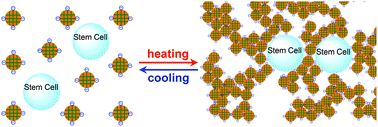
Hydrogels were synthesized from poly(N-isopropylacrylamide-co-acrylic acid) microgels, which formed hydrogels upon heating to 37 C thus encapsulating the murine embryonic mesenchymal progenitor cell
(C3H/10T1/2). The hydrogel reverted back to microgels and cell release upon cooling. This cooling allowed recovery of the cells, which were then able to adhere to a 2D surface. Experiments were done to further characterize, image, and test cell cytotoxicity on the gels.

Graphical abstract: Exploring thermal reversible hydrogels for stem cell expansion in three-dimensions

Directed persistent motion maintains sheet integrity during multi-cellular spreading and migration

Kenechukwu David Nnetu, Melanie Knorr, Dan Strehle, Mareike Zink and Josef A. K€as

http://pubs.rsc.org/en/Content/ArticleLanding/2012/SM/C2SM07208D?utm_source=feedburner&utm_medium=feed&utm_campaign=Feed%3A+rss%2FSM+%28RSC+-+Soft+Matter+latest+articles%29

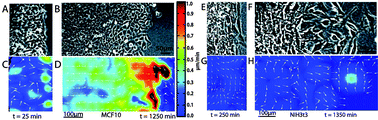
This research group is studying the collective cell migration properties of the following cell monolayers: MCF-10A epithelial cells has weak cell-cell adherence and single cells could detach; MDA-MB-231 epithelial cells could not detach from each other; and NIH 3t3 fibroblast cells did not interact and could not migrate together. They studied the dynamics of the cell monolayers, for example, they found evidence on the heterogenity of the MCF-10A cells with the lower cell density regions having higher velocities. As well, the cells were treated with EGTA (ethylene glycol tetraacetic acid), which chelates calcium and reduces intercellular interactions. This experiment showed that even at high cell densities in which cells did not readily detach in the MCF-10A monolayer, introduction of the chelator did promote single cell detachment and monolayers could move toward the cells detached or the escaped cells could move back into the monolayer. Overall, the researchers suggest that cell dynamics plays an important role in collective cell migration and these cell-cell interactions can produce stable boundaries.
Graphical abstract: Directed persistent motion maintains sheet integrity during multi-cellular spreading and migration